Looking for some lighter reads for my job-library's collection, I thought that I would have a look at the novellas that were either winners or nominees for the Hugo and Nebula Awards. I've been meaning to do this for a really long time, but now I had a very good excuse for having a look.
Of course, Nnedi Okorafor's name has popped up here and there for a while in other award lists, and I had also been wanting to read something of hers... so this was a perfect moment to do so.
Tor publishing will give you a good deal on these novellas for Kindle so I bought the first one not knowing what to expect.
I was amazed! I was smitten! I was grateful that the other two novellas in this series were available right now! Never have I been so happy about buying something online and getting that instant gratification of reading as soon as possible! Binti was wonderful, and the following novellas were great too.
I enjoyed them so much that I didn't stop there. I have bought most of Okorafor's other books as well, and I am going to read as many as possible this year. I am especially looking forward to reading her comic books.
So, if you just want a quick read, an introductory jolt of African futurism, this is where to start. I have just read an article recently that supports this idea at Bookriot. I can't wait to read what comes next.
Showing posts with label Science Fiction. Show all posts
Monday, March 4, 2019
Friday, May 12, 2017
Remembrance Of Earth's Past
Another Hugo Award winner, this first book The Three-Body Problem was exciting, so exciting that I had to read the following two books. I listened to the audio versions of the first two, and read the last one as an e-book earlier this year. Either medium was excellent, I enjoyed each book thoroughly. This is a trilogy that is truly epic in its telling throughout all three books (something I did not expect since the middle book is what I have typically considered to be just filler... a place saver until you get to the end of the series when it gets all exciting again. But The Dark Forest kicked butt all on it's own and was more exciting than the first book in its own unique way. I actually wondered what more Cixin could say after I finished The Dark Forest, it had all seemed pretty well sewn up by the end. Oh boy was I surprised, jubilant even, while reading the third book Death's End. I was cheering at one point, oohing and ahhing at another point, while still being pretty clueless as to how it would all play out in the end. Reading these books was like bouncing on a trampoline... I never stayed still. There was a various array of feelings running through me from one segment to the next (though it was never exhausting as emotional upheavals can be, it was always gentle).
I have raved enough about The Three-Body Problem that my husband went out and bought a copy of the first two books. I plan on reading them when we have the complete set as I figure that there is much that I would have missed listening to the audio book. I think it says a lot about a book, especially hard/military science fiction genre books like these, that I would want to return to the story again.
This is science fiction with what I consider to be the traditional story telling style of the Chinese saga. There are so many components to the books it reminded me of Romance of the Three kingdoms and had such a classic way of relating events that had me also thinking of Journey To the West. These fractions of stories all wove together to make an incredible and inevitable result (which Cixin has very carefully helped you to understand that there could not be any other way to conclude his story). It's clever and original and not what I have come to expect from a regular "Earth is being invaded by hostile aliens and this is how we fought them" type of story. Death's End is nominated for the Hugo this year, I wish Cixin Liu the best of luck.
Saturday, June 18, 2016
Bellwether
It was just yesterday that I was waxing poetic about To Say Nothing of the Dog, and here I am today ready to get 'all lyrical' about Bellwether. I admit, the write up on the back cover did not encourage me to read this book a few years ago when I started collecting Connie Willis, but after a few more of her books under my belt, I trust her implicitly and will read anything she has ever done.
You don't really need a time-travelling shtick to get in to this book, like everything else I have ever read by Willis, you are drawn in almost instantly. Last night I just decided to indulge myself by reading Bellwether until I couldn't stay awake any longer, and then I picked it up first thing this morning and read on until the finish (it is a habit with me to 'ration' out the good books by only reading small amounts at a time, trying to make them last longer), so not only am I breaking my rules by reading more than one of Willis' book in a year, I am swallowing them whole as well.
It felt like my IQ had gone up a few points when I was done. The overall theme to this story is chaos theory (and the fascinating way fads originate and apply to it), and I am impressed with how it was used as a story telling device. I think that when I get back to doing the re-reads on Willis' work, I will confirm that this is used in her other works too. Chaos theory as plot device.
An interesting thing to note is that later this morning I was looking at Pinterest for the first time in a few months, and my whole outlook on it has changed drastically after reading Bellwether.
To conclude, a Connie Willis book will, make you laugh, learn something new, increase your intelligence and change your world views. Maybe I should make t-shirts!
Friday, June 17, 2016
To Say Nothing of the Dog
Since reading Blackout/All Clear I have been hooked on Connie Willis. I have collected all of her major works to date and have been jealously hoarding them ever since (only reading one of them a year). What's really awesome is that she is still alive...so that means she might write some more, which is great, but I still find myself stingily doling out the love an an annual basis. I mention this because I have dared to begin reading a second one by Connie this same calendar year, and it has me panicking a little!
But today I am talking about To Say Nothing of the Dog. I read this in February, and it was the last of her books written about her Time Travel series. I really hope that she will write more, they are just that good! It won the Hugo and the Locus award.
This book was mainly situated in the Victorian era. As usual, a couple of things go wrong for the historians visiting there and the protagonist Ned Henry is sent to fix things up. Unfortunately for Ned, he has been time travelling a lot recently and he is suffering from 'time lag'. After being shoved in to the time net, he has forgotten half of his damage control instructions, thus making the mission go 'pear-shaped' in a comically tragic way.
The main things I love about these stories is that I learn a lot of history (and it's all very interesting), there are a lot of literary references (which I love to follow up on... this time I bought the Kindle bundle of Jerome K. Jerome's complete works), and there are lots of unforgettable characters. When things go wrong it's all very engrossing, exciting, and best of all gets me chuckling throughout the read, greedily gobbling up pages of the story to the very end.
What is also nice, I suppose, is that even though you have finished the book, there are lots of things to look up and read about, so it helps to keep me busy and not think too much about there not being another book in the series.
Friday, November 14, 2014
Blackout/AllClear
I read the first half of this dynamic duo a few years back as part of a selection of women authors who have won Nebula Awards. I loved it until I got to the end, when I thought,"What's going on here, isn't she cutting it a bit close?" The book begins with a lot of almost harried activity...there is just so much going on, and underlying is this tension and an uneasy sense that things are tragically going to go to pot, the suspense is just building up with no real release. Anyone who's read my blog knows just how annoyed I get when I make these discoveries (I hate to read a book and then have to wait for the sequel), but I take all the blame because I didn't do the research. I was left hanging after finishing Blackout! I have done the research now. As a matter of fact I have bought several of Connie Willis' books in preparation for reading this pair, and it works to my advantage because in another of her books Firewatch (a collection of short stories) is one about this particular universe, so it was with a smug feeling that I began the books, first with the short story Firewatch and then on to Blackout and finishing up with All Clear.
Naturally I chose November to read this as during this month I usually read someting that has some relation to the World Wars, and these two did not disappoint. I got an unusual education about an era in our history that is already so well documented. It was a true homage to the English people, those folks who lived through the Blitz and afterward. If you want to step in to history, this is a good way to do it. I loved the books from beginning to end, and since there is over 1100 pages, there's a lot to love.
I look forward to reading more of Connie Willis' books as these two were so well researched and written, I can understand why she has won so many awards for her genre.
Friday, September 6, 2013
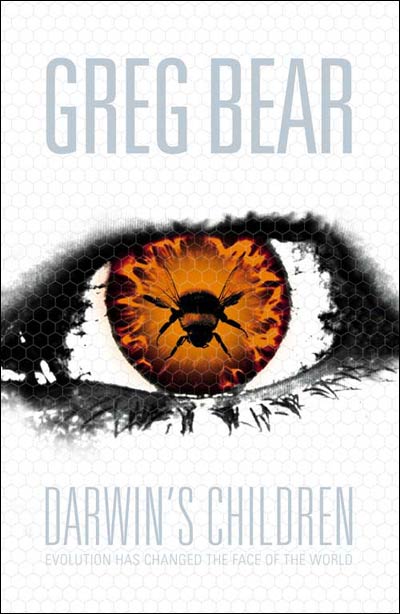
Darwin's Radio
I have always had a hard time with the type of science fiction books which are really more about the science than the fiction. Understandably there had to be a lot of science for the subjects in this book (evolution and biology), but it felt like a punishment for me to have to slog through it, which takes from my enjoyment and interest.
Griping aside, this book was food for thought, and made me wonder what we will evolve into eventually. We have lots of options thanks to popular fiction (Isaac Asimov’s future history is my favourite choice here...when there was robots naturally...) and television shows (the Star Trek universe), but in the actual future, how will we really turn out? I can’t possibly predict. Any ideas?
Friday, August 23, 2013
Man Plus
This is my first book by Frederik Pohl, and I am impressed with the thought put in to this particular subject; the processes needed to adapt a human to survive on the surface of Mars. The detailed metamorphosis is astonishing, and the whole experience is shared by the reader, the shock, the betrayal, the personal relationships and politics behind such an endeavour. Pohl throws you through a loop at the end though…watch out!
Tuesday, July 9, 2013
Rite of Passage
Yet another of those post-Earth books with a different vision of how we (Earthlings that is…) all manage to survive the apocalypse… except this time there is no Earth (it has been destroyed in an unexplained manner). Again we have survivors, somewhere in the not too distant future, who have evolved into their own separate cultures, one of the ship people and the other of the Colons (people who made it planet side). The division is thus, and the protagonist lives on one of these ships, which is a world in an asteroid, a floating, cruising world, that goes between colonised planets, trading knowledge and science for material goods. It all sounds good, though perhaps a little unfair for those planet side who no longer have the technology of the ships, and we are shown, through Mia (our strong female protagonist), the changing of perceptions, and the evolutionary changes of a people who, despite their advantages in technology, have lost some things in their place, like art, music and literature. Rite of Passage was very well written, riveting in fact, and some points were made that I thought were very interesting and applicable today. Well worthy of it’s Nebula.
Sunday, June 9, 2013
The Einstein Intersection
I read this because it won the Nebula Award. It is actually the second book by Delany to win this award. If it hadn't been for that reason I don't think I would have attempted it, because after my first experience with a Delany book I haven't felt the need to read another. He's not a bad writer! Just an abstract one, which makes you work very hard to grasp what he is portraying. The story was almost essay-like (the way I write an essay is to plot my thesis, and then map out the points and approaches of my arguments), but it was disappointing to me because the points he was trying to make where not obvious to me even though he had basically laid everything out for you to put together, he just wasn't going to do it for you (this made me think it was unfinished). Add to this challenge a badly converted e-book, and the confusion is just annoying. But, there's more! Misleading popular culture references will point you in the wrong direction and you have the novel in it's bewildering, annoying whole. I can see what is going on, but I'm pissed that the chaotic presentation detracted from what I suspect could have been a really good book. Maybe, if I ever come across this in a second hand book store, I might buy it and give it another go. Maybe. Neil Gaiman wrote a foreward for it, so I am guessing for him it was a great inspiration to go ahead and write a novel chock-a-block full of gods from many diverse mythologies, a progenitor for him so to speak to create American Gods. I recognised the parralels to Earth mythologies in The Einstein Intersection, I just couldn't understand their relevance to the story (even when you are given a weak explanation at the end).
So, my conclusion is this, electronic books are not always what they are cracked up to be, especially conversions from old books, though that isn't always the case... I have read actual books that are that obscure and seem to deliberately make it difficult to connect the dots (Divisadero anyone?). I plan to stick with actual paper books for as long as I can when it comes to older editions. Oh, and Samuel R. Delaney is an aquired taste, which I don't have.
The Toynbee Convector
It is really interesting to see what Ray Bradbury's focus was about later on in his very long life. It all makes sense of course, an old love story, a long and enduring marriage, haunting memories from past wars, time-travellers, real or invented. The theme for this book was time that has passed, it is an homage to things long gone. I think the older Ray got the cheekier he became too (the story Junior being an excellent example of that! Only Ray would write a story about an eighty-two year old man's erection), and of course the man who discovered that his childhood fear of the bogeyman was not so unfounded after all, when he decided to go back and confront that fear. Cheeky!
Sunday, May 26, 2013
The Machineries of Joy
I am presented with points of view that I have never considered before:- Irish Catholic Priests in America faced with the unknowns of the birth of space travel. A gaseous entity encountering humans for the first time on Mars. A Hollywood monster-maker whose tyrannosarus rex becomes too lifelike. The last family in America going on vacation. The fears of a drummer boy about to go into battle. Invasion through fungi. The calamity of losing radio and television on a small town. Indians seeing white men for the first time ever. A sea captain still in mourning for his lost love. The Day of Death in Mexico. A pshychiatrist presented with an illustrated woman. A son strangled by his mother. An understanding of the worth of a true miracle. The insanity of a murderous ventriloquist. The beggar as a professional. The obsession with death of an old spinster who has never really lived. The hazards of success. The importance placed in Mexico of a place to stay when you are dead. An old man remembering a better way of life. Irish competitiveness. I can safely say that I will never look at mushrooms the same way again...
Wednesday, May 22, 2013
Blackout
Silly, silly me, I did not find out first if this was part of a series. Not that I mind... it just means that it will be a re-read at a later date after I have bought the rest.
I read this because it was a Nebula winner, and you can take it from me that this book has earnt it's laurels. I have never read Connie Willis before and I enjoyed myself so much that I want to collect the rest of her books and read them in the order intended. While reading this book there were many references to things that I realise now were from past books and not from further along in this one... right up to almost the very end (the third last page!) I had expected this to conclude, and boy was I surprised that it was not so. It's my own fault... internet access for me is spotty at best and taking the time to do the research before-hand has not been an appealing prospect.
What is appealing, however is reading the rest of these stories and whatever else Willis has written.
American Elsewhere
I had the tremendous good fortune to win this book from the Librarything Early Reviewers book group. It was love at first sight! While it was just an advanced copy (and could have used a bit more glue on the spine publisher chaps!), it was a pleasant handful of book, large, a little heavy and very easy to hold in your hands (nice and bendy). It was also over 660 pages of non-stop suspense, intrigue,mystery and persistent horror (meaning that I was always anxious about what was going to happen next just like watching a horror movie, and the feeling never let up…at all!), it was such a pleasure to read from start to finish. I really didn’t want the book to end.
When I began I was impressed with how it reminded me of my favourite television show Eureka, thougn that impression didn’t last very long as it swiftly turned into something more serious and ominous (you guys remember David Lynch’s
Twin Peaks? Yeah it was that damn ominous). Despite getting creeped out (horror has never really been my favourite genre), I didn’t want to put the book down, but forced myself to because I didn’t want the story to end so quickly, so it was my bedside book for the last week (and I always read well past my bedtime!).
I looked at Robert Jackson Bennett’s website yesterday after I had finished American Elsewhere and I was blown away by a picture he had posted of the rabbit suit and mask, because that was almost exactly how I had pictured it, which just cranks up my admiration for Bennett’s ability to paint pictures and evoke feelings with his words. I also discovered that he has written a few other books that I will be buying as soon as I possibly can, and of course I will be keeping an eye out for whatever else this writer will produce in the future.
Wednesday, March 6, 2013
It's a Strain Alright...
It's just one of those lists that I have been trying to fill out... the books to movie one for science fiction. Or is it the other way around? I suspect that there is very little that is different between either. That isn't criticism! Just merely the statement that you could either read the book or watch the movie and you wouldn't be missing anything. Crichton's got to be good considering how many of his books have made it onto film.
It's just not my cup of tea. In this instance, I think the movie is better than the book because you don't get too bogged down wth the technojargon (which always automatically switches off any interest I may have). Either version of the movie is neat and nifty in a very insipid paranoia-inducing way, the seventies version for nostaligia's sake (they made so many pre and post apocalyptic shows in that era, it's hard not to be fond of them) and the tv movie that they made in the last decade with newer technology but the same effect (the creepy-heebeegeebee-paranoia effect).
Secret germ warfare facilities out in the desert ready to blow at any time...yep, that's creepy. And probably true...
Monday, February 11, 2013
Android Karenina
I love a good mash-up. I didn't always feel that way, I resisted Pride and Prejudice and Zombies, and it wasn't until DH had given me Sense and Sensibility and Seamonsters for Christmas one year that I finally had a look and found it to be quite funny. There was no stopping me then! It isn't as I had feared, the original books were treated with respect, not contempt. There is however one mash-up that did not turn out well... The Meowmorphosis. I have too much love for the original (I always passionately defend the ones that make me cry), and this treatment was not meant to be, perhaps because the original already had a fantastic storyline and changing it from a cockroach to a kitten, didn't end up being very funny or even very cute.
Reading as I have recently The Elegance of the Hedgehog where scenes from the original Anna Karenin was mentioned quite often it was funny to see the Ben Winters version and appreciate the thought and humour that he had put into such a monumental book. It was sweet because there was so much of Leo Tolstoy there, but with some humour as well thanks to Ben. I want to go back now and re-read the original, but that won't be a good idea for a year or so yet. Don't miss the questions at the end... they are hilarious!
Dreamsnake
Not the most alluring title...I have been off fantasy ( I am just so tired of the ginormous line of sequels that follow these days) for a while now favoring science fiction over everything, but this one surprised me. It's another Nebula winner which is why I cracked it open, and mercifully, I was drawn into the story on the first page. What seems a very fantasy-ish book is just that but even more. It is about civilization after a nuclear war. So we are talking way-way-way-post-apocalyptic fiction, with just a few hints of ancient civilization thrown in to make me curious (I just love when it can or might be traced back to good old Earth!).
It had a kind of Planet of the Apes feel to it, you know the one where Charlton Heston discovers what is left over of the human race (not the mute Adam and Eve types), the creepy pale mutants who's heads are so far up their own butts they cant see anything but their own tummies? Yeah... like that.
It was a good story, a pleasant sidetrack from what I have been reading recently, Vonda really knows how to pack it all in to one engaging and satisfying package.
Saturday, February 9, 2013
Flowers For Algernon
This is a wonderful book! I gobbled it up in one day and was crying by the end (a good indicator of how it affected me).
It won the Nebula Award in 1966 which is how it got onto my reading radar (I am working on reading the Nebula winners this year), and it truly did merit the award. Being more realistic fiction than science fiction because even though science is the catalyst for the story, it is told in progress reports written by the protagonist and they were riveting reads. I can't really say more than that as I would hate to give away the plot, so just go and get it and read it ok?
Friday, January 11, 2013
The Anything Box
I was put on to this writer through reading Amongst Others by Jo Walton, and I'm glad I had a look at her stories. Given that this was a collection of short stories (and I am a little ho hum about that considering the amount of short stories I know I will be reading this year), I wasn't disappointed in this collection. They were strongly Bradburyesque in their creep-factor, but I really liked them. I was reminded of a Brother's Grimm type of storytelling but with a modern and spacey spin.
Kids, to me, in a science fiction/fantasy story always represent the wild cards... you just don't know what might happen and it can get pretty scary and tense or wonderful. Throw teachers in to the mix and it goes over the top in potential nastiness or greatness. I had to laugh at the comment one of the teachers made about just giving a kid a yell and a smack if they don't get in line... how far we have come since Zenna Henderson was a teacher!
Babel 17
My first Delany! I am systematically working through all of the Nebula Award winners, and he was next on the list. Babel 17 was a little murky, but I grew interested anyway. Babel-17 has, I believe, been an influence to other authors I have read, which was neat.
I strongly suspect that Douglas Adams borrowed the concept of Babel 17 for his very own Babel fish and I have to wonder if David Bowie had read it too, because it was the first thing that popped into my mind when, in a part of the book, the audience applauded with finger clicks (remember the video for Blue Jean?). If I hadn't raced through the story perhaps I might have traced other future influences, but I was in a hurry to see how this story would end. Delaney put quite a bit of development into his universe, though I felt that there was something lacking to this story, there was something not told or finished yet, so many loose ends flapping about. Which is always a pain in the arse, but it's worth a re-read in the future.
Saturday, January 5, 2013
The Lathe of Heaven
I love that Ursula K. Le Guin was so perceptive. Imagining the future is not for the faint of heart and she pulled it off without getting out of hand or making it so unrecognisable that you couldn't take it seriously. I was hooked, almost from the start, by my own foreshadowings of what might happen next. I didn't think that anything good could come of it, I just couldn't predict what was going to happen which was a pleasant suprise. There is so much to consider after reading this book, it would take a re-read or two to grasp the most basic of Le Guin's concepts, there are, as she put it in the story 'layers of the onion still not peeled off'. This is the first adult book of Le Guin's that I have ever read, and I'm sorry that it has taken me so long to start. I will be making an effort in the future to get my hands on whatever else she has written, because she has earned my esteem and respect with this novel and I would love to see what else this brilliant woman has come up with.
Subscribe to:
Posts (Atom)


.jpg)


.jpg)